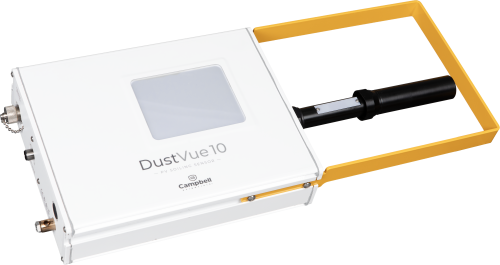
Uses the IEC 61724‑1 preferred soiling ratio measurement method while eliminating costly manual cleaning and specific environmental calibrations


Aperçu
Reliable soiling measurements require a stable reference.
Soiling loss is determined by comparing a clean reference surface to a naturally soiled surface. If the reference condition changes, the measurement changes—even when the array does not.
Many soiling monitoring approaches depend on routine cleaning, wash systems, or modeled corrections to preserve the reference condition. These methods can introduce uncertainty because the measurement accuracy becomes tied to maintenance consistency rather than instrument stability. When the reference is uncertain, operators cannot confidently separate true energy loss from measurement error.
The DustVue™10 addresses this limitation directly.
This sensor measures photovoltaic (PV) soiling loss using collocated clean and naturally soiled PV reference cells in accordance with the preferred methodology described in IEC 61724-1. The clean reference is automatically protected, maintaining a consistent baseline without reliance on manual cleaning schedules or correction assumptions.
With a stable reference, soiling data supports operational decisions.
Wash scheduling, performance attribution, and reporting can be based on repeatable measurements instead of inferred conditions.
Lire la suiteAvantages et caractéristiques
- IEC-Aligned Measurement Basis – Collocated clean and naturally soiled PV reference cells that measure actual performance impact using the methodology defined in IEC 61724-1
- High Measurement Accuracy – Designed to achieve repeatable soiling loss measurements suitable for operational decisions and performance analysis
- Stabilized Clean Reference – Automated protection that preserves the reference condition without dependence on routine manual cleaning
- Reduced Maintenance Requirements – Eliminates wash systems and frequent technician intervention required by traditional reference methods
- Operational Decision Support – Provides consistent data for wash optimization, loss attribution, and performance verification
- Bifacial Assessment in One Device – Simultaneous front- and rear-side soiling evaluation from a single instrument platform
- Integration Simplicity – Modbus RTU over RS-485 to support connection to plant SCADA, data loggers, and monitoring systems
- Built for Continuous Field Operation – Self-contained instrument designed for long-term deployment in utility-scale PV environments
Images
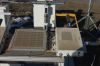
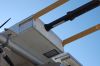
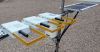
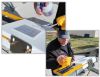

Fichiers 3D/CAD :
Description technique
Measurement Principle (IEC 61724-1 Preferred Method)
The DustVue 10 directly measures PV soiling losses using collocated clean and naturally soiled PV reference cells, consistent with the preferred methodology described in IEC 61724-1. Rather than estimating soiling from optical transmission or particulate accumulation proxies, the sensor quantifies the performance impact attributable to contamination on PV-representative surfaces.
Because both reference cells are collocated, they experience the same irradiance, spectral, and temperature environment. This enables the reported soiling loss to reflect true performance impact under real operating conditions, supporting decision-making and analysis workflows that require defensible, PV-relevant data.
Reference Stability (Automated Clean-Reference Protection)
The reliability of any soiling measurement depends on maintaining a stable clean reference condition over time. Traditional approaches often require routine manual cleaning or water-spray systems to restore a reference surface, introducing uncertainty when that cleaning is inconsistent, delayed, or incomplete.
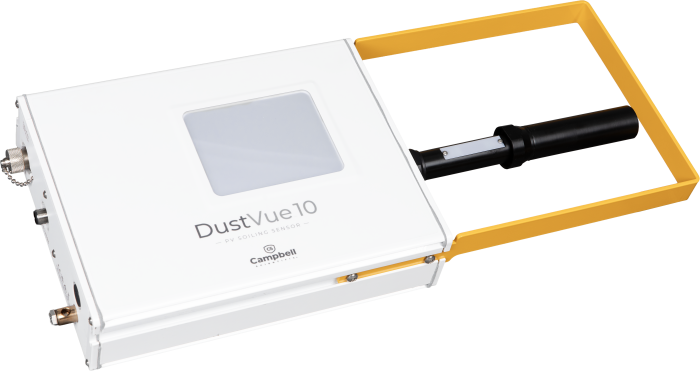
The DustVue 10 is designed to maintain reference integrity by preventing contamination of the clean reference. A motorized protective cover shields the clean reference and exposes it only during suitable measurement conditions. This approach reduces dependence on routine intervention and minimizes uncertainty associated with partially cleaned or re-contaminated references.
Environmental Operation (Separating Transient Effects from Soiling)
Short-duration environmental effects, such as moisture, dew, or rapidly changing irradiance, can influence surface conditions differently than particulate soiling. By measuring two adjacent PV reference surfaces under the same ambient conditions, the DustVue 10 isolates the performance impact attributable to contamination, rather than conflating soiling loss with transient environmental variability.
The objective is a soiling loss signal that remains operationally meaningful for wash timing, loss attribution, and performance discussions.
Accuracy and Decision-Grade Data
The DustVue 10 is designed to achieve soiling loss measurement accuracy within ±1% under proper installation and operating conditions. This level of accuracy supports use cases where the data must withstand scrutiny, such as wash optimization, performance verification, and contractual or stakeholder reporting.
Bifacial Capability (Front + Rear in One Instrument)
For bifacial PV installations, the DustVue 10 supports simultaneous front- and rear-side soiling measurements within a single instrument platform. This reduces instrumentation complexity compared to approaches requiring duplicate sensors or separate measurement strategies for each side of the array.
Integration and Communications (Modbus RTU over RS-485)
The DustVue 10 is designed for straightforward integration into plant monitoring and SCADA environments using Modbus RTU over RS-485. This enables compatibility with a wide range of data loggers, RTUs, and SCADA systems that support standard Modbus communications—without specialized interfaces.
This integration approach simplifies incorporating into existing architectures for trending, alarm logic, reporting, and analytics workflows.
Deployment and Maintenance Profile
The DustVue 10 is a small, self-contained instrument designed for long-term outdoor deployment in utility-scale PV environments. By avoiding routine water-spray systems and minimizing manual reference cleaning requirements, the instrument is intended to reduce ongoing O&M burden while preserving the integrity of the measurement basis over time.
The goal is a soiling measurement that operators and analysts can rely on continuously—without building the measurement’s credibility around frequent maintenance procedures.
Operational Use Cases
The DustVue 10 is intended to provide a consistent basis for:
- Wash scheduling optimization and verification
- Performance reconciliation and loss attribution
- Stakeholder and contractual performance discussions
- Ongoing plant reporting and analytics
By stabilizing the reference condition and simplifying integration, the instrument supports workflows where measurement confidence is as important as measurement availability.
Spécifications
| Operating Temperature Range | -20° to +70°C (The sensor meets stated accuracy specifications within this range.) |
| Storage and Survival Temperature Range | -40° to +70°C (The sensor will not be damaged. No soiling ratio will be measured below -20°C.) |
| Soiling Ratio Uncertainty | ±1% |
| Input Power | 12 to 32 Vdc |
| Power Consumption - Idle |
|
| Power Consumption - Active |
|
| Power Consumption - Active with Heater Full on | ~24 W |
| -NOTE- | A small heater prevents the cover gasket from freezing shut, which could interfere with measurements or damage the gasket. The heater can be active when the ambient temperature is below 5°C and when humidity and temperature conditions could cause frost. |
| Communications | Modbus RTU over RS-485 |
| IP Rating | IP65 |
| Shipping Dimensions | 27.94 x 58.42 x 11.43 cm (11 x 23 x 4.5 in.) |
| Shipping Weight | 3.54 kg (7.8 lb) |
Documents à télécharger
Vidéos & Tutoriels

Téléchargements
DustVue 10 OS v.1.03 (1.59 MB) 07-05-2026
Current operating system for the DustVue 10.
DustVue 10 Program Example v.1 (3 KB) 10-06-2026
Use this program as a template to create a program to read and write to the registers on a DustVue 10 sensor.